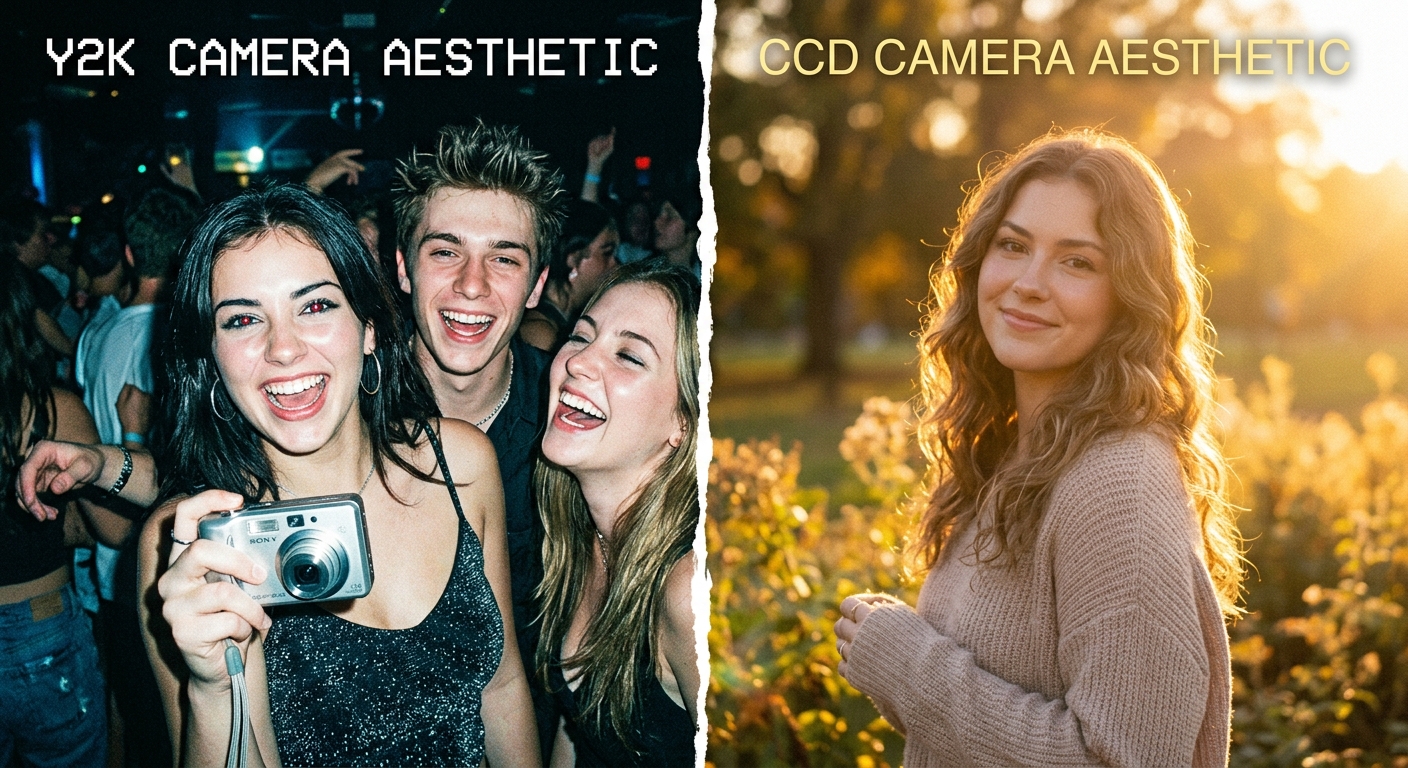

If you’ve been diving into retro photo aesthetics, you’ve probably seen two terms thrown around constantly: Y2K camera and CCD camera.
They sound similar. They’re both digital. They’re both nostalgic. But they’re not the same thing.
In fact, mixing them up is one of the fastest ways to get the wrong vibe for your photos.
So what’s the difference? And which one should you use?
Let’s break it down.
What Is a Y2K Camera?
The Y2K camera aesthetic comes from early digital cameras made between 1998-2005. Think Canon PowerShot, Sony Cyber-shot, Nikon Coolpix — the chunky plastic cameras that your parents used to shoot birthday parties and family vacations.
Visual Characteristics
Y2K photos have a distinct look:
- Overblown flash: Harsh, direct lighting that makes faces glow and backgrounds disappear into darkness
- Cool color temperature: Blue-green tint, especially under fluorescent lights
- High contrast & saturation: Colors are punchy and unnatural — reds pop, blues are electric
- Visible digital grain: Low ISO performance means indoor shots have noticeable noise
- Low resolution: 3-5 megapixels max, so images look soft and slightly pixelated
- Date/time stamps: Orange or white timestamps in the corner (optional but iconic)
The Vibe
Y2K camera photos feel raw, unpolished, and authentic. They capture the energy of early-2000s nightlife, house parties, mall hangouts, and teen culture.
Best for: Party photos, nightlife, candid moments, TikTok throwbacks

What Is a CCD Camera?
CCD camera refers to digital cameras with CCD (Charge-Coupled Device) sensors, which were common from the mid-2000s to early 2010s (roughly 2004-2012).
CCD sensors produced a warmer, softer, more film-like aesthetic compared to modern CMOS sensors.
Visual Characteristics
CCD photos have a different feel:
- Warm color temperature: Yellow-orange glow, especially in golden hour or indoor lighting
- Softer grain: More organic and film-like, less digital-looking than Y2K cameras
- Lower contrast: Colors are rich but not as punchy as Y2K aesthetics
- Analog feel: Despite being digital, CCD photos have a quality that mimics film
- Medium resolution: 5-10 megapixels (better than early Y2K cameras but still limited by today’s standards)
- Subtle bloom/halation: Highlights glow softly, creating a dreamy effect
The Vibe
CCD camera photos feel nostalgic, dreamy, and cinematic. They’re less harsh than Y2K, more artistic, and closer to film photography.
Best for: Street photography, golden hour portraits, travel photos, artistic projects

Y2K Camera vs CCD Camera: Side-by-Side Comparison
Here’s how they stack up:
| Feature | Y2K Camera (1998-2005) | CCD Camera (2004-2012) |
|---|---|---|
| Era | Early digital cameras | Mid-2000s digital cameras |
| Color Temperature | Cool (blue-green cast) | Warm (yellow-orange glow) |
| Flash | Overblown, harsh | Softer, more balanced |
| Grain/Noise | Digital, sharp grain | Organic, film-like grain |
| Contrast | High (punchy colors) | Medium (natural tones) |
| Resolution | 3-5MP | 5-10MP |
| Vibe | Raw, energetic, party | Dreamy, nostalgic, cinematic |
| Best Use | Nightlife, candid moments | Street photography, portraits |
Can a Camera Be Both Y2K and CCD?
Yes — but it’s about how you use it.
Technically, many early Y2K cameras did use CCD sensors. But when we talk about “CCD camera aesthetic” today, we’re usually referring to later-generation CCD cameras (2004-2012) that had better sensors, warmer color science, and softer grain.
The key difference isn’t the sensor — it’s the era and the aesthetic choices.
- Y2K aesthetic = early digital cameras, harsh flash, cool tones, low resolution
- CCD aesthetic = mid-2000s digital cameras, warm tones, softer grain, film-like quality
Which One Should You Use?
It depends on what vibe you’re going for.
Choose Y2K Camera If:
- You want that early-2000s party energy
- Your photos are candid, nightlife, or flash-heavy
- You’re posting on TikTok or Instagram and want instant nostalgia
- You like bold, punchy colors and don’t mind overblown flash
Choose CCD Camera If:
- You want a dreamy, cinematic feel
- Your photos are artistic, moody, or shot in natural light
- You prefer warm tones and soft grain over harsh flash
- You’re creating art projects, street photography, or portraits
Can You Mix Both Styles?
Absolutely. Many photographers layer Y2K flash effects on top of CCD color grading to create a hybrid aesthetic.
For example:
- Shoot in warm, natural light (CCD vibe)
- Add a subtle flash overlay (Y2K vibe)
- Apply soft grain (CCD) + date stamp (Y2K)
This gives you the best of both worlds: nostalgic warmth + raw energy.
How to Get Y2K and CCD Effects Without Vintage Cameras
Here’s the secret: you don’t need to buy a $200 vintage camera to get either look.
Modern AI tools can recreate both Y2K and CCD aesthetics digitally — with better resolution, full editing control, and zero hardware hassle.
Method 1: Mobile Apps (Limited)
Apps like Huji Cam, Dazz Cam, and 1998 Cam offer Y2K and CCD presets. They’re easy to use but have major downsides:
- ❌ Generic filters (everyone’s photos look identical)
- ❌ Low output resolution
- ❌ Watermarks on free versions
- ❌ No fine-tuning control
Method 2: AI-Powered Tools (Best Option)
AI tools like PopCam analyze the color science, grain structure, and lighting of real vintage cameras — then recreate them in seconds.
Why this works better:
- ✅ Both Y2K and CCD presets in one tool
- ✅ High-resolution output (no quality loss)
- ✅ Customizable settings (adjust flash, grain, color tone)
- ✅ No watermarks
- ✅ Works on any photo (past, present, future)
FAQs
Are Y2K cameras and CCD cameras the same thing?
No. Y2K refers to early digital cameras (1998-2005) with a specific aesthetic: harsh flash, cool tones, high contrast. CCD refers to cameras with CCD sensors (2004-2012) that produced warmer, softer, more film-like images.
Can modern phones recreate Y2K and CCD looks?
Not natively. Modern smartphones use CMOS sensors and computational photography, which produce clean, HDR-processed images. To get Y2K or CCD aesthetics, you need apps or AI tools.
Which aesthetic is more popular in 2026?
Y2K is trending harder on TikTok and Instagram (nostalgic party vibes). CCD is more niche but growing in artistic and photography communities.
Can I get both effects from the same tool?
Yes! Tools like PopCam offer both Y2K and CCD presets, so you can switch between styles depending on your photo.
Final Thoughts
Y2K camera = early digital, flash-heavy, cool-toned, raw party energy.
CCD camera = mid-2000s digital, warm-toned, soft grain, dreamy cinematic feel.
They’re both nostalgic. They’re both retro. But they serve different vibes.
Want Y2K? Go for harsh flash and bold colors.
Want CCD? Go for warm tones and soft grain.
Want both? Use an AI tool that gives you full control.
No vintage gear. No expensive cameras. Just instant nostalgia.
Leave a Reply